

What the 15-Minute City Means for Developers

The city of short distances
The 15-minute city is a measurable quality criterion for residential locations. All essential everyday destinations should be within 15 minutes of the place of residence: Local amenities, work, education, health, leisure, green spaces and public transport stops - on foot, by bike or by public transport.
For property developers, the 15-minute city is an economic argument and the only realistic way to densify in locations where the parking space regulations block any additional storeys. After all, anyone who can prove that residents can manage without their own car can reduce the number of mandatory parking spaces. And if you can reduce the number of parking spaces, you can build.
The central problem: the parking space regulation blocks redensification and adding storeys
Anyone planning redensification or building extensions today quickly comes up against a decisive limit - the parking space regulations.
The Vienna Garage Act (WGarG), for example, stipulates one car parking space per 100 m² of usable living space for residential buildings. This obligation applies regardless of whether the future residents even own a car and has three specific consequences for construction projects:
- Additions of storeys fail due to the parking space requirement. In many cases, anyone who wants to build additional storeys on an existing building must also provide proof of parking spaces for new residential units. Often there is not enough space on the plot.
- Underground car parks make projects massively more expensive. Depending on the location and construction method, an underground car park costs between 25,000 and 60,000 euros. This is often more than the market will bear.
- Car parking spaces tie up space that is lacking elsewhere. Car parks take up land that is not available for housing, green spaces or sensible mobility infrastructure.
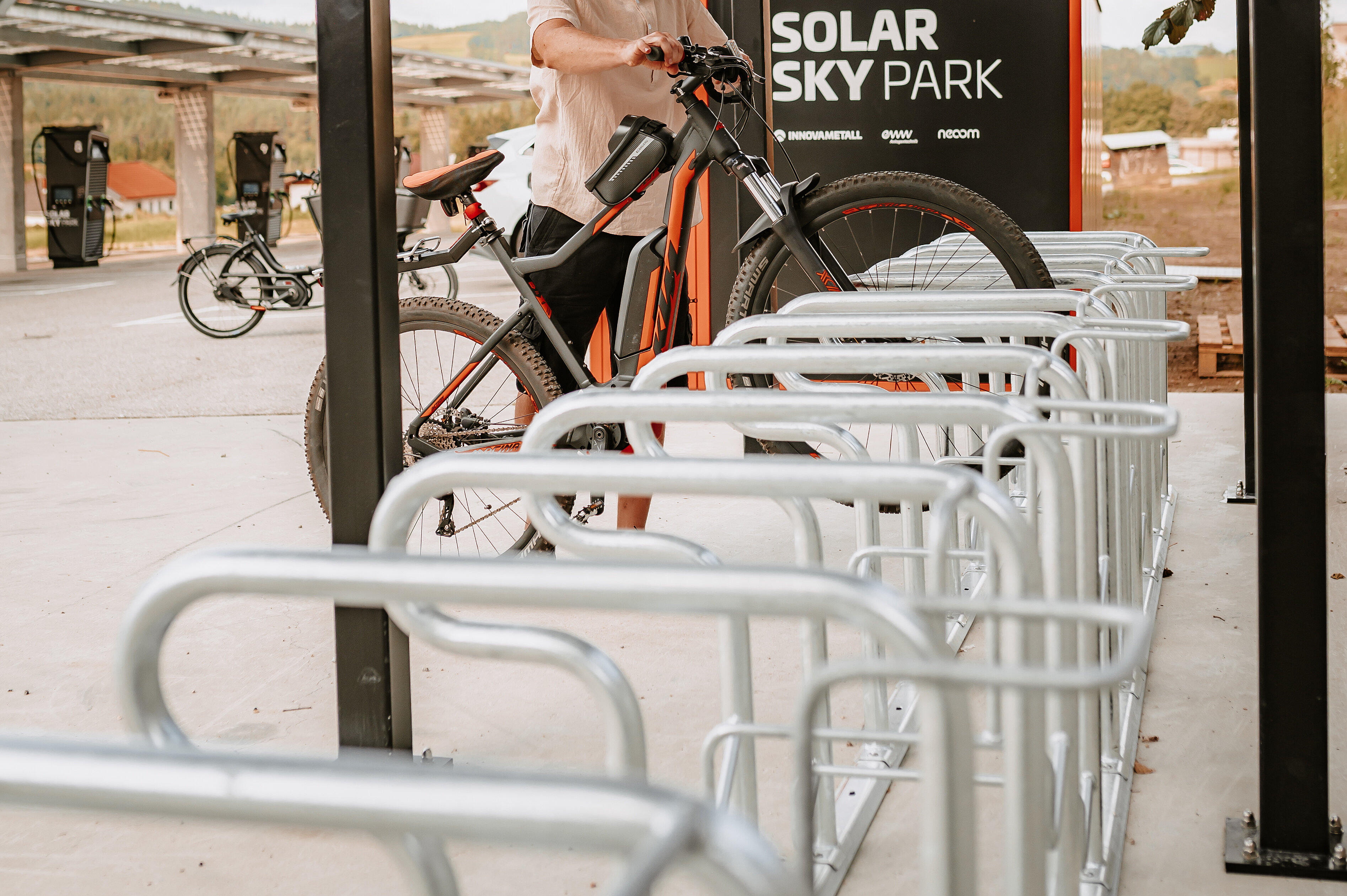
Reduce parking spaces with an alternative mobility concept
Anyone who presents a qualified mobility concept has a concrete instrument in their hands. Not just any bike box will suffice as proof. Authorities expect substantial solutions that are suitable for everyday use and are actually utilised. A recognised mobility concept for neighbourhoods must include the following:
- Secure, ground-level bicycle parking facilities with charging points for e-bikes instead of basement compartments. Without direct lift access, e-bike users are unlikely to use bicycle storage facilities.
- Lockable bike boxes for commuters who need to park their bikes securely every day.
- Charging infrastructure for e-bikes and cargo bikes with easy access solutions.
- Rental cargo bikes that enable shopping and child transport without a car. This is a direct added value for families in particular.
- Car-sharing vehicles replace your own car or at least a second car.
- Direct, convenient connection to public transport - illuminated, weather-protected, barrier-free.

Mobility hubs: when all solutions are bundled in one place
The mobility hub is the decisive leap in quality compared to isolated solutions. It bundles bicycle parking, charging points, sharing services and public transport connections at a central point, ideally right by the main entrance.
Residents turn to mobility alternatives when the effort involved is less than with their own car: ground-level accessibility instead of a basement ramp, immediate availability instead of reservation effort, intuitive operation instead of registration hurdles. The first and last mile is particularly relevant - whether someone takes the train is often decided on the way from their home to the station.
Wien-Süd - Koloniestraße: Integrated mobility hub in the new building
A complete mobility concept was implemented in the new building: spacious bicycle storage room with service station, secure safetydock mobility station with bicycle boxes including charging function, cargo bike hire and parcel station. The result: lower parking space requirements and a demonstrable marketing advantage over comparable projects.
Linz - Heindlstraße: Retrofitting in existing buildings with measurable results
A safetydock mobility station was installed in the inner courtyard of the WAG Heindlstraße residential complex as part of a refurbishment project: lockable e-bike boxes including cargo bike hire combined with a bicycle canopy and charging points for e-cars. The residents have been using the facility every day since 2017 - for shopping or travelling to work without having to rely on their own car. Almost ten years of operation show: Mobility solutions for neighbourhoods also work in existing buildings and are an effective lever for upgrading locations without building a single new car parking space.
Why mobility solutions are becoming a marketing argument
According to Statistics Austria, more than a third of Viennese households did not own a car in 2023 - and the trend is rising. Offering living space that can be fully utilised without a car appeals to a growing target group: Households that consciously choose not to own a car, families interested in low fixed costs and commuters who use e-bikes or public transport for their daily journeys.
This is relevant for property developers and investors: Not only the building, but the entire neighbourhood gains in value in the long term.
What needs to be done now
Mobility solutions must be considered from the initial planning phase - not as an additional service at the end, but as an integral part of the project structure.
1. check parking space regulations at an early stage. What reductions does the responsible building authority recognise with qualified proof of mobility? In Vienna, the municipal department 37 (building police) decides and the zoning of the property is the first decisive parameter.
2. integrate mobility from the outset. Routing, ground floor zones, public transport interfaces and sharing areas must be planned in the design phase.
3. usability before formality. A mobility concept is only relevant for approval and effective in everyday life if residents actually use it - this requires ground-level accessibility, intuitive operation and bundled services in one place.
INNOVAMETALL develops and implements mobility infrastructure as an integrable system for residential complexes, neighbourhoods and redensification projects